Living traditions for a sustainable world
Indian Knowledge Systems (IKS) encompass all forms of human thought and action derived from the culture of the Indian subcontinent over the course of thousands of years.
Vice President Jagdeep Dhankhar on Thursday said colonisation produced clerks and yeomen instead of thinkers, while grades replaced critical thinking.




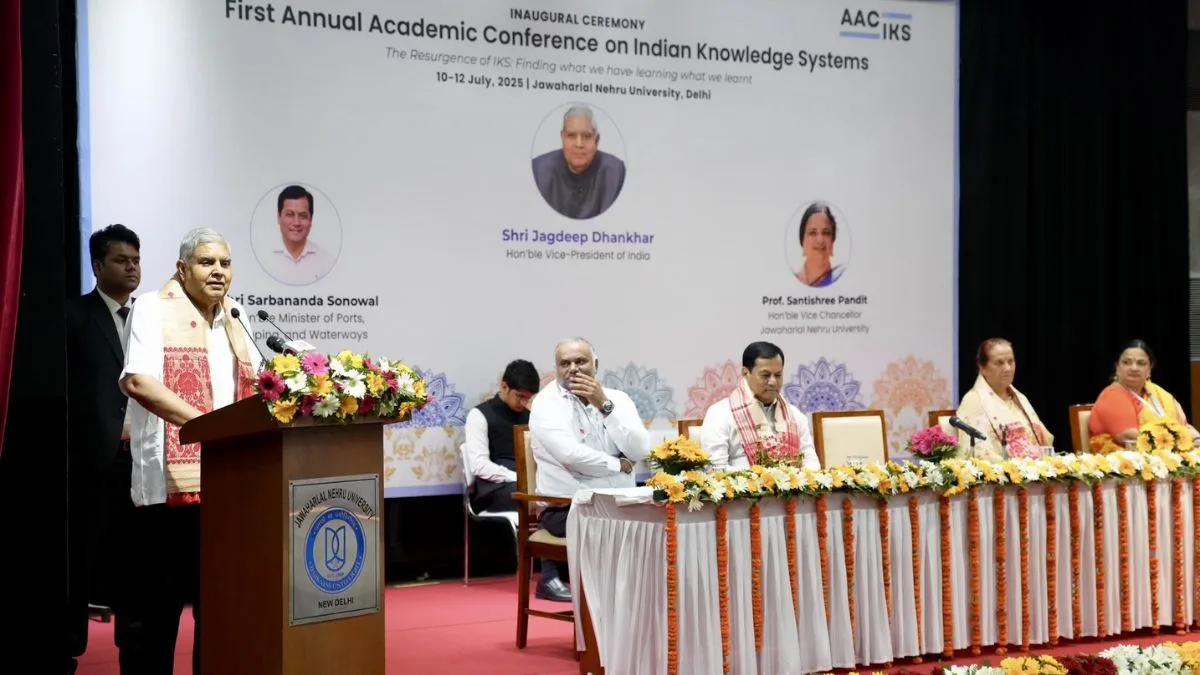
X/@VPIndia
Vice President Jagdeep Dhankhar on Thursday said colonisation produced clerks and yeomen instead of thinkers, while grades replaced critical thinking.
Addressing the inaugural annual conference on the Indian Knowledge Systems (IKS) here as the Chief Guest, Dhankhar reflected on the historical ruptures in India’s intellectual journey.
Advertisement
“The Islamic invasion of India marked the first interlude in the glorious journey of Bharatiya Vidya Parampara. Instead of embrace and assimilation, there was contempt and destruction. British colonisation brought forth the second interlude, when the Indian Knowledge System was stunted, stymied, and subverted. Centres of learning changed their motives. The compass was moderated. The North Star was changed. From bearing Sages and Savants, it started producing clerks and yeomen. The needs of the East India Company to have brown babus replaced the need of the nation to have thinkers,” he said.
Advertisement
“We stopped thinking, contemplating, writing, and philosophising. We started cramming, regurgitating, and swallowing. Grades, unfortunately, replaced critical thinking. The great Bharatiya Vidya Parampara and its allied institutions were systematically drained, destroyed, and decimated,” the Vice President said.
Dhankhar said, “Long before the universities of Europe came into being, Bharat’s universities had already established themselves as thriving centres of learning. Our ancient land was home to luminous centres of intellectual life—Takshashila, Nalanda, Vikramashila, Vallabhi, and Odantapuri. These were the towering citadels of knowledge. Their libraries were vast oceans of wisdom, housing tens of thousands of manuscripts.”
“These were global universities, where seekers came from lands near and far, such as Korea, China, Tibet, and Persia. These were the spaces where the intellect of the world embraced the spirit of Bharat,” he added.
Dhankhar said India’s rise as a global power must be accompanied by the rise of its intellectual and cultural gravitas.
“This is very significant because a rise without this is neither lasting nor in harmony with our traditions. The strength of a nation lies in the originality of its thought, the timelessness of its values, and the resilience of its intellectual traditions. That is the kind of soft power that endures, and soft power is potent in the world we live in,” he said.
Advertisement